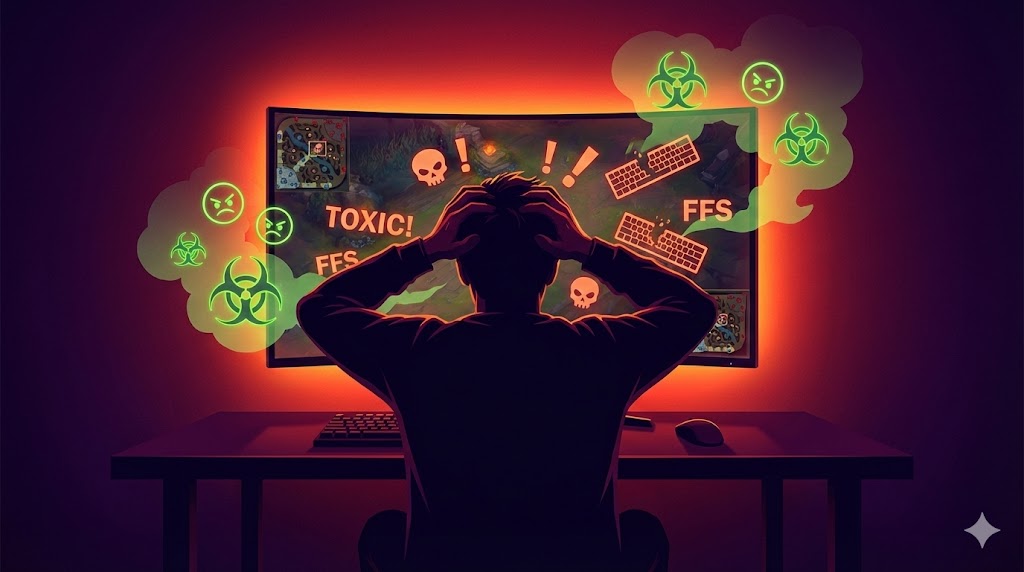
If you've spent more than five minutes in a League of Legends match, you've probably seen it. The ADC blaming their support for existing. The jungler getting flamed for not ganking a losing lane. The mid laner going full keyboard warrior because someone pinged them once.
It's almost a rite of passage at this point — you don't really play League until someone has wished unspeakable things upon your family in all chat.
But why? Why is League of Legends so absurdly, legendarily toxic? It's not like other games don't have bad apples, but LoL seems to breed them like it's running some kind of industrial salt farm. Let's break down exactly why this game turns normal people into raging goblins, and what makes the toxicity so much worse here than in other games.
The 40-Minute Prison Sentence
Here's the thing about League that sets it apart from most other multiplayer games: you're trapped.
In Counter-Strike or Valorant, rounds are quick. Lose one? Whatever, next round. In battle royales, you die and you're out — queue up for another. But in League? You're locked into a match for 25-45 minutes minimum, and if things go south early, you've got no escape.
Imagine being stuck in a meeting that's going terribly, but you can't leave because leaving means your account gets punished. That's every losing League game. The frustration compounds every minute. By the 30-minute mark of a clearly lost game, people aren't just tilted — they're cooked. They've been marinating in their own misery for half an hour with no release valve.
This is the core issue. The game design literally traps unhappy players together. Surrender votes fail because two people still think they can miracle a win, and now you've got three teammates who've mentally checked out and one guy typing essays about how terrible everyone is. It's a pressure cooker, and toxicity is what comes out.
The Blame Game is Built Into the DNA
League is a team game where individual performance is brutally visible. Your KDA is public. Your CS score is public. Your deaths show up as announcements to everyone in the game. There's no hiding when you mess up.
And here's the psychological trap: when you lose, it's very easy to look at your team and find reasons why it wasn't your fault. Oh, the jungler didn't gank. The bot lane fed. Top lost before I even finished my first item. The human brain is wired to protect the ego, and League gives you endless ammunition to blame someone else.
Other team games have this too, but League is special because of how the snowball works. One person doing poorly doesn't just hurt — it actively helps the enemy. When your top laner dies three times, the enemy top laner isn't just winning lane. They're now a raid boss who will probably one-shot your ADC. Your teammate's failure becomes your nightmare.
This creates resentment. Real, visceral resentment. And resentment leads to typing things you shouldn't.
Anonymous Strangers You'll Never See Again
Let's not pretend this is just a League problem — it's an internet problem. Put people behind anonymous usernames where they'll never face real consequences, and a percentage of them will turn into absolute menaces.
But League amps this up because:
The Dunning-Kruger Express
I'm not saying you're bad at League. But I am saying that a lot of League players think they're significantly better than they actually are. This leads to a phenomenon we can call the "Hardstuck Delusion."
The Delusion Cycle:
- Player is stuck in Gold for 400 games
- Player believes they deserve Diamond but their teammates keep them down
- Player enters every game expecting teammates to fail
- Teammates make normal mistakes (everyone does)
- Player rage-types because "confirmation bias says I was right"
When everyone thinks they're the best player in the lobby, every mistake from others feels like a personal insult. "Why is this idiot in my game?" becomes the default thought, when the reality is: Riot's matchmaking put you together because you're statistically similar. If your teammate is trash, the algorithm thinks you are too. And that's not something the ego wants to hear.
Curious what the algorithm actually thinks of you? Our free MMR checker will show you the number Riot doesn't want you to see. And if you want to understand how that number actually works, check out our complete MMR guide.
Ranked Anxiety is Real
There's something psychologically brutal about watching your LP go up and down. League's ranked system creates an emotional investment that casual games don't have. You're not just playing for fun — you're playing for validation. Your rank is your identity.
When someone threatens that identity by playing poorly in your promo series, the reaction isn't logical. It's emotional. It's fight-or-flight but for your MMR. People type things they'd never say in real life because in that moment, losing this game feels catastrophic. It's not. But it feels that way.
This is why normals and ARAMs are significantly less toxic. The stakes are lower, so people care less, so the flame is quieter. Ranked is where the real demons come out.
The ranked tilt spiral is real. You lose a game, you queue again immediately because you want to "get it back." You're already tilted. You play worse. You lose again. Now you're furious. You flame your team. You lose a third. Three games, -60 LP, and a chat restriction. Sound familiar?
The Mute Button Isn't a Solution
Yeah sure, you can mute. But here's the brutal truth: toxicity has already done its damage before you mute.
When someone flames you in the first five minutes, you're now tilted. Even if you mute them, you know they're probably still typing about you. The mental space is occupied. You're playing worse because part of your brain is now dealing with the emotional response to being attacked.
And muting doesn't solve the gameplay griefing. The guy who decides to run it down because he didn't get his role. The jungler who refuses to gank your lane because you pinged for help once. The support who "accidentally" takes CS because they're passive-aggressive. Muting stops the chat, but it doesn't stop the behavior.
The Smurfing Problem
Let's talk about the elephant in the room. Smurfing is both a cause and effect of toxicity.
High-ELO players smurf because their main account queues are long and games are stressful. They want to feel powerful again, so they create new accounts to stomp lower-ranked players. This sounds fun for the smurf, but it's miserable for the actual Gold players getting destroyed by someone who clearly doesn't belong there.
But here's the twist: smurfs are often the most toxic players in the lobby. They expect their lower-ranked teammates to play at a level they can't, and when teammates make normal mistakes, the smurf goes nuclear. "I'm trying to carry these bots" mentality.
Meanwhile, the players getting stomped by obvious smurfs become tilted and toxic themselves. "Why is this level 35 account going 18-0? Nice matchmaking, Riot." The frustration spreads.
It's a cycle. Toxicity creates smurfs who want to escape their toxic games. Smurfs create more toxicity. And it goes on forever.
If you're going to smurf, do it right. Buying a sketchy $2 account from Discord just adds to the problem. If you want a fresh start without the drama, at least use an aged, Vanguard-safe smurf that won't get banned in the next wave. Read our Vanguard safety guide to understand why account quality matters in 2026.
Riot's Punishment System is a Joke
Real talk: Riot's behavioral systems are not good at stopping toxic players. The Instant Feedback System catches obvious slurs and trigger words, but anyone who's creative enough to avoid the banned words basically has free reign.
Players have learned to be "strategically toxic." Don't type slurs — type question mark pings fifty times. Don't say you're inting — just "accidentally" die in the enemy jungle repeatedly. Don't flame directly — just passive-aggressively type "nice flash" or "?" after every teammate death.
The system can't detect attitude. It struggles with soft inting. And even when players do get punished, the punishment cycle (chat restriction → 14-day ban → permanent ban) takes forever. A truly dedicated toxic player can ruin hundreds of games before they face real consequences.
The Game Itself is Incredibly Frustrating
Let's be honest: League of Legends is hard. Not just "learn the controls" hard — fundamentally, painfully difficult to master.
There are over 160 champions. Each has unique abilities, power spikes, and counterplay. The item system is deep. Wave management matters. Jungle pathing matters. Macro decisions, micro mechanics, objective control, draft optimization — the list is endless.
When you invest time learning all this and still lose because your bot lane didn't respect the enemy level 2 spike, it feels awful. The game complexity makes every loss feel like it could have been prevented if someone just knew more. And that leads to frustration at others.
Simpler games don't have this problem. In Fall Guys, if you lose, it's just funny. In League, if you lose, it's because someone somewhere made a mistake that you probably noticed, and that knowledge burns.
The Community Normalizes It
Here's the cultural problem: League toxicity is a meme. People joke about it. Content creators build brands around flaming their teammates (lookin' at you, Tyler1's old content). The community has accepted toxicity as part of the experience rather than something to fight against.
New players show up, experience toxicity, and think: "Oh, this is just how it is." They either adopt the behavior or leave. The ones who stay become desensitized. "It's not that toxic" say the veterans who have been marinading in it for ten years and no longer recognize normal human interaction.
This is why the problem persists. It's not just bad actors — it's a culture that tolerates, expects, and sometimes celebrates being terrible to each other.
What Actually Helps
If you're reading this and thinking "great, so there's no hope?" — not quite. Here's what actually reduces the toxicity impact:
If you want to actually improve and climb instead of just surviving the toxicity, check out our guides on carrying low elo and getting better at League. Winning more games is the best antidote to tilt.
The Hard Truth
League of Legends is toxic because it's a perfect storm: long games you can't leave, visible performance metrics, anonymous teammates, high-stakes ranked ladders, and a culture that's tolerated bad behavior for over a decade. It's not one thing — it's everything.
Will it get better? Maybe. Riot has made improvements over the years. The report system works more than people give it credit for. Toxicity punishments do happen. But the core game design isn't changing, and as long as you're trapped in 40-minute games with strangers who can ruin your day, the salt will flow.
The best thing you can do is protect your own mental, mute liberally, and remember: it's just a game. Your rank doesn't define you. That 0-10 Yasuo can't hurt you in real life. And at the end of the day, we're all just clicking buttons and hoping not to get flamed.
Need a Fresh Start?
Escape the ranked anxiety on your main. Clean MMR, no history, no baggage.
Frequently Asked Questions
Why is League of Legends considered the most toxic game? League combines several factors that amplify toxicity: long matches you can't leave (25-45 minutes), visible individual performance stats that invite blame, anonymous teammates, high-stakes ranked ladders, and a decade-old culture that normalizes bad behavior. Most other competitive games don't trap frustrated players together for as long.
Does muting actually help with toxicity in League? Muting stops the chat, but it doesn't undo the tilt from being flamed, and it can't stop gameplay griefing like soft inting or refusing to cooperate. It's still worth doing early — removing the chat distraction lets you focus on your own play. But it's a band-aid, not a cure.
Is League more toxic than Valorant or CS2? League is generally considered more toxic because of the game length and snowball mechanics. In Valorant or CS2, rounds are short and individual rounds don't snowball as hard. In League, one teammate feeding early can make the entire game feel unwinnable for 30+ minutes.
Does Riot actually punish toxic players? Yes, but the system is slow and imperfect. The Instant Feedback System catches obvious slurs and trigger words quickly, but "strategic toxicity" (excessive pings, soft inting, passive-aggressive behavior) is much harder to detect. Repeated reports do lead to chat restrictions, temporary bans, and eventually permanent bans.
Why is ranked more toxic than normals? Ranked creates emotional investment through LP gains and losses. Your rank feels like part of your identity, so when a teammate threatens that by playing poorly, the reaction is emotional rather than logical. Normals and ARAMs have lower stakes, so people care less and flame less.