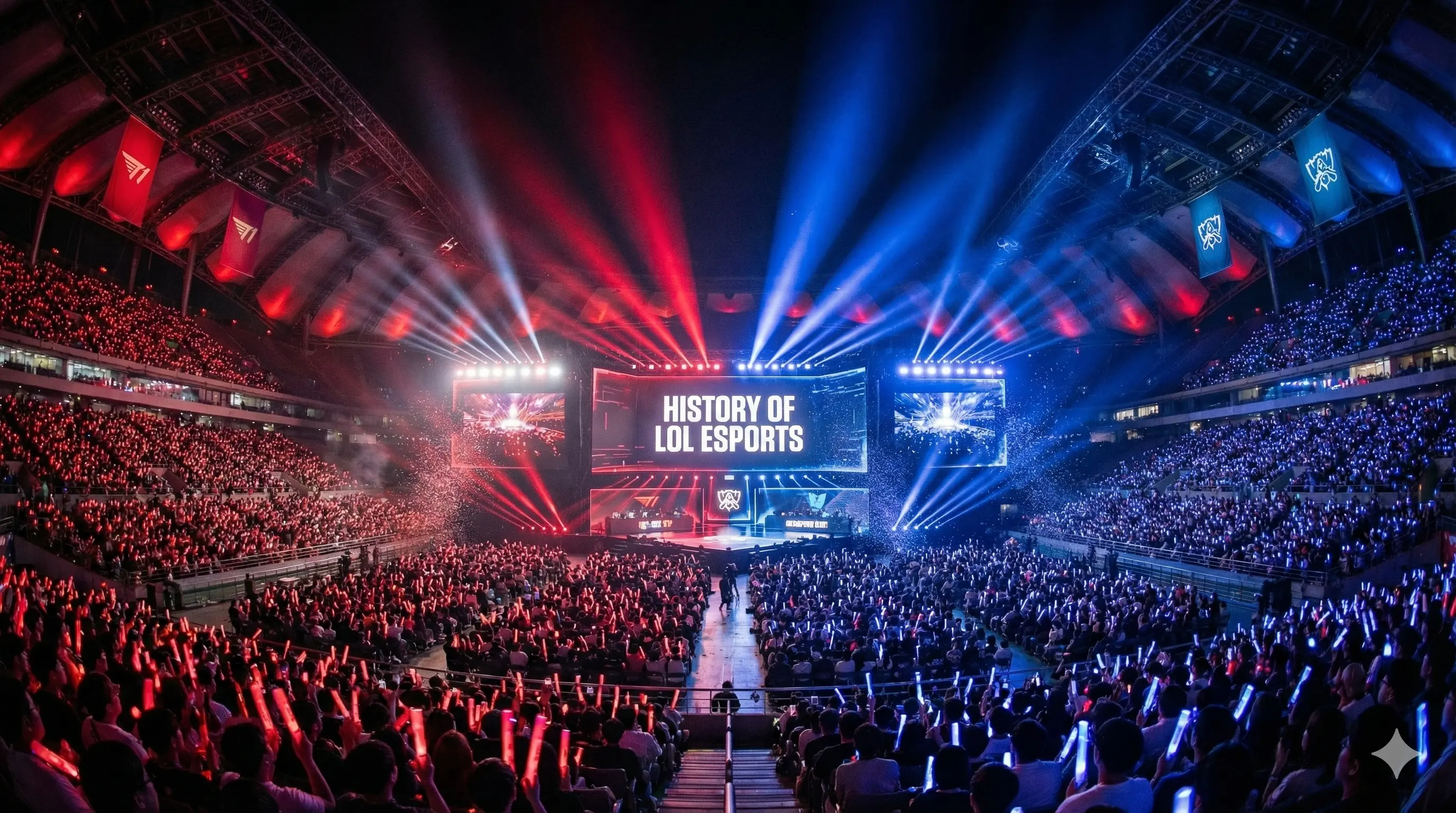
In 2026, esports is just... normal. You turn on Twitch (or YouTube), and you see a broadcast quality that rivals the Super Bowl. You see Augmented Reality dragons flying around sold-out Olympic stadiums. You see players wearing jerseys with sponsors from luxury car brands, signing contracts worth millions of dollars.
But for those of us who have been around since the beginning, this reality is still kind of insane. Because we remember where it started. We remember the folding chairs. We remember the lag. We remember when "esports" was just a bunch of nerds in a basement trying to play a video game for gas money.
The history of League of Legends esports is a Cinderella story that literally built the modern industry. Here is how we got from there to here.
Season 1: Phreak's Basement (2011)
People joke about "Phreak's Basement," but the Season 1 World Championship wasn't far off. The Venue: DreamHack Summer in Jönköping, Sweden. It wasn't even the main stage. It was a roped-off section of the convention floor. The Prize Pool: $100,000. At the time, this was headline news. "Video game tournament offers $100k!" it was unthinkable.
If you watch the VODs, it's hysterical.
- There were no soundproof booths. Players could hear the casters screaming "HE'S IN THE BUSH!"
- The setup was basically a LAN party.
- Fnatic won the whole thing, cementing xPeke and Shushei (remember the Gragas cosplay?) as the first legends.
- The "Trophy" was... questionable.
It was raw. It was messy. But it had heart. It proved that people *wanted* to watch this game.
Season 2: The Internet Dies (2012)
Riot saw the potential and decided to go big. The Venue: The Galen Center in Los Angeles. A real basketball arena. The Prize Pool: $2,000,000. The largest in esports history.
This was the year the Taipei Assassins (TPA) shocked the world, proving that "minor" regions could slay giants. It was the ultimate underdog story.
But Season 2 is also infamous for the technical disasters. During the quarterfinal between CLG.EU and World Elite, the internet crashed. Not once. Multiple times. The series dragged on for over 8 hours. The crowd ran out of energy, the casters ran out of jokes, and they eventually had to send everyone home and play the rest of the match days later in an empty studio. It was a PR nightmare, but it forced Riot to develop the "Tournament Realm" (offline LAN server), ensuring the game could never crash like that again.
Season 3: The Faker Era Begins (2013)
This is the year League became a "Sport." The Venue: The Staples Center (home of the LA Lakers). The Outcome: SK Telecom T1 debuted a skinny, awkward teenager named Faker.
Faker didn't just win; he revolutionized how the game was played. He played Riven Mid. He played Nidalee Mid. His Zed vs. Ryu outplay is still, to this day, the most famous clip in the history of the game. "LOOK AT THE CLEANSE! LOOK AT THE MOVES! FAKER! WHAT WAS THAT?!"
Winning at the Staples Center was the proof of concept. It showed sponsors that gamers would buy tickets. It showed TV networks that this wasn't a fad. The "Nerd Stigma" began to die that day.
Season 4-7: The Korean Dynasty
For the next four years, the script was written in Korean. The LCK (Korean League) became the NBA of League of Legends.
- Samsung White (2014) played the game with such perfection it looked like a script.
- SKT T1 won back-to-back titles (2015, 2016).
- Samsung Galaxy (2017) ended the SKT dynasty in the Bird's Nest stadium in Beijing.
It became a meme: "Korean Overlords." The West (NA/EU) would get hyped, make it to groups, and get absolutely dismantled by Korean macro play. It was an era of perfection, but also—dare I say it—a little boring. The gap was too wide.
2018-2019: The Gap Closes
Then, the impossible happened. The dynasty fell.
- IG (Invictus Gaming) brought the trophy to China (LPL) for the first time in 2018, proving that raw, chaotic aggression could beat calculated macro.
- G2 Esports (Europe) won MSI 2019 and made it to the Worlds Finals.
This era was peak entertainment. We saw "G2 Pyke Top." We saw "Funnel Strat." We saw innovation. The meta exploded, and suddenly, any region could win on any day.
The Modern Era (2026): A Global Spectacle
Today, the ecosystem is massive. We have the Fearless Draft format (introduced in 2025), which bans champions once they are played in a series, forcing pros to have champion pools as deep as the ocean. We have global leagues with salaried players who are treated like professional athletes, complete with nutritionists, sports psychologists, and agents.
The storylines run deep. We have players like Deft and Faker who have been competing for 15 years, playing alongside 17-year-old prodigies who weren't even born when the game launched.
Why It Matters
League of Legends esports proved that video games are not just a pastime. They are a culture. Watching the Worlds Finals is no different than watching the Super Bowl or the World Cup. You cheer for your region, you cry when they lose, and you spam "NA AIRPORT SPEEDRUN" in chat when they inevitably fail in groups.
That community—toxic, loud, passionate, and enduring—is what keeps the game alive after 16 years.
Want to play on the same servers as the pros? If you want to test your skills in the regions that built esports history, you need the right account.
- EUW Accounts: Play on the server known for the highest mechanical skill in the West. This is where Caps and Perkz were forged.
- NA Accounts: Home of the LCS. Come for the content, stay for the drama.
- OCE Accounts: A smaller, tighter community where everyone knows everyone.
The path to pro starts with your first ranked game. Good luck, summoner.