Here's something nobody tells you: playing more games doesn't make you better. It makes you more experienced at being the same rank.
Think about it. You've played hundreds, maybe thousands of ranked games. You know what every champion does. You know Dragon spawns at 5 minutes. You know you should ward. And yet — you're the same rank you were a year ago. Maybe two years ago.
That's because there's a difference between playing and practicing. Playing is autopilot. You queue up, you do your thing, you win some, you lose some, you go next. Practicing is intentional. You pick one specific thing to work on, you focus on it for 50 games, and you measure whether you're getting better at it.
Most players have never practiced a single thing in League. They just play. And then they wonder why they're not improving.
This guide is about the six skills that actually separate ranks — and how to practice each one without losing your mind.
The Six Skills That Decide Your Rank
Every player, from Iron to Challenger, is a combination of these six skills. You don't need to be great at all of them to climb. You need to be *less bad* at the ones you're worst at.
The one-at-a-time rule: Don't try to improve all six at once. Pick the one you're worst at. Focus on it for 50 games. Then move to the next one. Trying to fix everything simultaneously means you fix nothing.
CS and Laning: The Skill Floor
I covered CS numbers in the low elo carry guide, but let's go deeper here. Farming isn't just about hitting minions. It's about *how* you hit them and what you're doing between last hits.
The Trading Stance
This is the concept that changed my laning phase more than anything else. Here's how it works:
When a minion in your wave is about to die, the enemy laner has to choose: last-hit the minion, or trade with you. If they go for the CS, you auto-attack them for free. If they trade with you, they miss the CS.
The trading stance means you walk up aggressively every time a minion is about to die. You're threatening an auto-attack. Most of the time, the enemy will take the CS and eat your damage. Over 10 minutes, those free autos add up to hundreds of HP of damage — enough to force them out of lane or set up a kill.
This works at every elo. Even Challenger players use trading stance. The difference is that in low elo, people don't punish you for it, so it's basically free.
Back Timing
When do you recall? Most low elo players recall when they're low HP. That's reactive. Good players recall when they have enough gold for their next item spike AND the wave is pushed into the enemy tower.
If you recall with the wave in the middle of the lane, you lose 2-3 waves of CS while walking back. That's 200+ gold gone. If you recall after crashing a big wave into their tower, the tower kills the minions before the wave bounces back, and you lose almost nothing.
The cannon wave rule: Try to base on cannon waves (every 3rd wave). Cannon minions have more HP, so the wave takes longer to push back to your side. This gives you more time to recall, buy, and walk back without missing CS.
Wave Management: The Skill That Breaks Open Games
Most players below Platinum have no idea what wave management is. They just auto-attack the wave, push it into the tower, and then stand around waiting for the next wave. This is wrong in about 80% of situations.
There are three things you can do with a wave:
Freeze
Stop the wave just outside your tower range. Only last-hit. Don't use abilities on the wave. The wave stays in the same spot, and the enemy has to overextend to farm — making them vulnerable to ganks.
When to freeze: When you're ahead and want to deny the enemy CS. When you're behind and want to farm safely. When your jungler is nearby and you want to set up a gank.
Slow Push
Kill the caster minions but leave the melee minions alive. Your wave will slowly build up into a huge wave of 2-3 stacked waves. When this crashes into the enemy tower, it takes a long time to clear, giving you time to roam, take jungle camps, or recall.
When to slow push: Before roaming to another lane. Before recalling. Before an objective spawn (Dragon/Baron) so the enemy has to choose between catching the wave and contesting the objective.
Fast Push
Kill everything as fast as possible. Shove the wave into the tower immediately.
When to fast push: When the enemy laner just died or recalled. When you need to roam RIGHT NOW. When you want to get tower plates.
The simple version: If you're winning lane, freeze. If you want to roam or recall, slow push then shove. If the enemy isn't in lane, fast push. That covers 90% of situations. The other 10% you'll learn from experience.
Map Awareness: The Cheat Code Nobody Uses
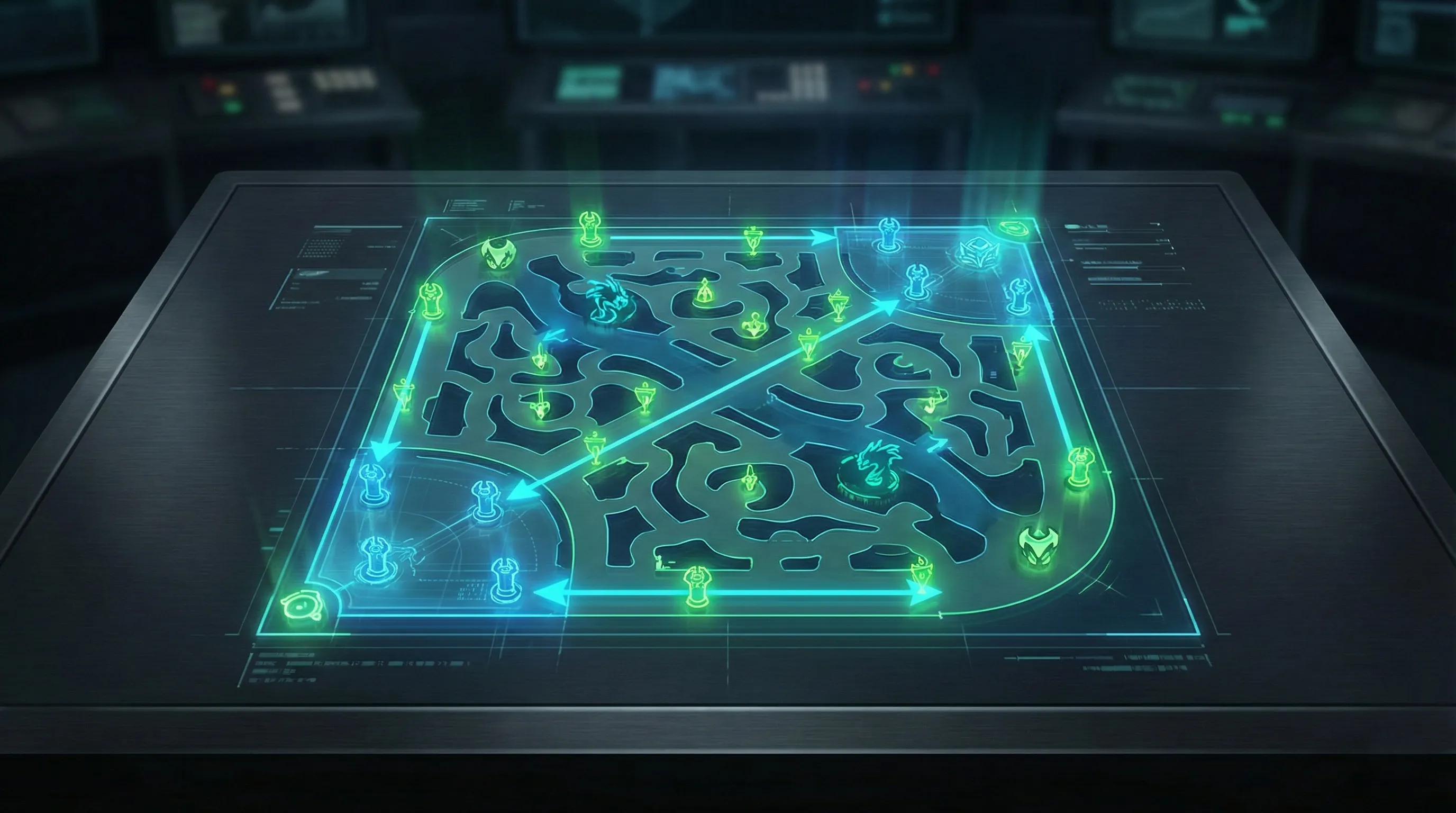
I'm going to make a bold claim: if you looked at your minimap every 3 seconds, you would gain at least one full tier. Not because map awareness is some secret technique — it's because almost nobody in low and mid elo actually does it.
Here's what checking the minimap tells you:
- Where the enemy jungler is (or isn't)
- Whether your lanes are winning or losing
- Whether you're about to get ganked
- Whether a roam is coming from mid
- Whether Dragon or Baron is being taken
That's an absurd amount of information, and it's sitting right there on your screen. You just have to look at it.
The 3-Second Rule
Every 3 seconds, glance at the minimap. Not a long stare — just a quick flick of your eyes. You're looking for one thing: has anything changed? Is someone missing? Is the jungler showing on a ward? Is a lane suddenly pushed in?
This sounds easy. It's not. Your brain is wired to focus on what's directly in front of you — your lane, your CS, the enemy laner. Training yourself to break that focus every 3 seconds takes deliberate practice.
How to practice: Set a metronome app on your phone to beep every 3 seconds. Play a normal game with it running. Every beep, look at the minimap. Do this for 10 games. After that, the habit starts to stick on its own.
If you die to a gank and the jungler was visible on a ward 5 seconds ago, that's not a "jungle diff." That's a you diff. The information was on your screen. You didn't look at it. Own it, and next time, look at the map.
Trading and Fighting: It's Not About Mechanics
Here's a take that might surprise you: mechanics barely matter below Diamond.
I don't mean you can play with your eyes closed. I mean that the mechanical difference between a Silver player and a Gold player is tiny. They can both hit skillshots. They can both execute basic combos. The difference is *when* they choose to fight and *who* they choose to hit.
Cooldown Trading
The simplest trading pattern in the game, and it works at every elo:
1. The enemy uses an ability on the wave (to farm or push) 2. That ability is now on cooldown for 6-12 seconds 3. You walk up and trade during that window 4. You win the trade because they're missing an ability
That's it. Wait for them to waste something, then punish. A Lux who just used her E to farm can't E you for the next 10 seconds. Walk up and hit her. A Darius who just used his Q on the wave can't Q you for 9 seconds. Trade into him.
Teamfight Target Selection
In low elo, everyone dives the enemy backline. The ADC flashes forward to hit the enemy ADC. The mid laner ignores the frontline to try to burst the enemy carry. Everyone dies.
Here's the rule: hit whoever is closest to you that you can safely damage. If that's the enemy tank, hit the tank. If the enemy ADC walks into your range, hit the ADC. But don't walk past three enemies to reach their backline — you'll die before you get there.
The exception is assassins. If you're playing Zed or Katarina, your job IS to reach the backline. But if you're playing Jinx, your job is to stay alive and auto-attack whatever's in front of you.
Decision Making: The Macro Game
Macro is the word people use for "big picture decisions." Where to be on the map. When to group. When to split push. When to take objectives.
Here's the thing about macro: it's not complicated. There are like five decisions that matter, and most of them come down to one question: "What's the most valuable thing I can do right now?"
| Situation | What to Do | Why |
|---|---|---|
| Just got a kill in lane | Push wave → take tower plates or roam | Convert the kill into something permanent |
| Dragon spawning in 60 seconds | Push your wave, then rotate | Arrive early, set up vision, don't lose CS |
| Your team aced the enemy | Take the highest-value objective available | Nexus > Inhib > Baron > Tower > Dragon |
| You're behind and enemy is grouped | Farm side lanes, avoid fights | You lose 5v5s when behind. Farm until you catch up. |
| Baron is up and you got a pick | Start Baron immediately (4v5) | Baron buff wins games. Don't waste the numbers advantage. |
| You have no idea what to do | Farm the nearest wave or jungle camp | When in doubt, get gold. Gold is never wrong. |
The "when in doubt, farm" rule is the single best macro advice for anyone below Diamond. If you don't know what to do, go farm something. A side lane wave, a jungle camp, anything. Standing around in mid lane doing nothing is the worst possible use of your time.
Self-Review: The Multiplier
Everything above is useless if you can't identify what you're doing wrong. And you can't identify what you're doing wrong in real-time — the game moves too fast, and your ego gets in the way.
That's why VOD review exists.
How to Actually Review Your Games
Don't watch the whole replay. That takes 30 minutes and you'll zone out. Instead:
1. Find your deaths. Skip through the replay and stop at every death. For each one, ask: "What could I have done differently to not die here?" Not "what could my team have done" — what could YOU have done.
2. Check your CS at 10 and 15 minutes. Compare it to the benchmarks. If you're below 7 CS/min, figure out where you're losing farm. Are you missing last hits? Are you roaming too much? Are you dying and missing waves?
3. Watch one teamfight. Slow it down. Watch your positioning. Watch who you're hitting. Did you focus the right target? Did you use your abilities at the right time? Did you die because you were standing in the wrong spot?
That's it. Three things. Takes 10 minutes. Do it after every loss (not every game — just losses). You'll start seeing patterns within a week.
The ego trap: When you watch your replay, your brain will immediately start making excuses. "Well, my jungler should have been there." "My support didn't peel." Stop. You're not reviewing your team's gameplay. You're reviewing yours. The only thing you can control is your own play. Focus on that.
What to Focus on at Each Rank
Not every skill matters equally at every rank. Here's what to prioritize based on where you are:
If you're Silver and you're trying to learn wave management, you're skipping steps. Get your CS to 7/min first. Learn to not die. Then worry about freezing and slow pushing.
The Practice Schedule That Works
You don't need to grind 10 games a day. You need to play 3-5 games with intention. Here's a weekly schedule that actually produces improvement:
Before your first game: 10 minutes in Practice Tool. Work on CS. Try to hit 90 CS by 10 minutes. This warms up your last-hitting and gets your brain into "focus mode."
During games: Pick ONE skill to focus on. Just one. This week it's map awareness? Then every game, your only goal is to check the minimap every 3 seconds. You might lose some games because you're not focused on other things. That's fine. You're practicing.
After a loss: 10-minute VOD review. Find your deaths. Check your CS. Watch one teamfight. Write down one thing you'll do differently next game.
After 50 games: Switch to a different skill. You focused on map awareness for 50 games? Now focus on wave management for the next 50.
This is slow. It's boring. It's not as fun as just queuing up and playing. But it works. And "just playing" clearly doesn't, or you wouldn't be reading this article.
When Improvement Isn't Enough
Sometimes the problem isn't your skill — it's your account. If you've been hardstuck for 500+ games, your MMR is locked in. The system has decided you belong at your current rank, and moving it requires an unreasonable number of games at a high win rate.
Use our free MMR checker to see where your hidden rating actually sits. If your LP gains are garbage (+14/-24), your MMR is below your rank and the system is actively working against you. At that point, you have two options: grind 200+ games to fix it, or start fresh on an account with clean MMR and apply everything you've learned.
A fresh start isn't giving up. It's recognizing that your improved skills deserve an account that reflects them. If you've genuinely gotten better but your old account's MMR won't budge, a new account lets you place where you actually belong. Curious how long the grind would take on your current account? Our climb calculator shows you exactly how many games you need to reach your target rank.
And make sure your settings are optimized before you start the grind. No point improving your gameplay if your FPS is tanking in teamfights.
Ready to Put It Into Practice?
Check your MMR, optimize your setup, and start climbing with intention.
---