Every ranked player hits this crossroads eventually. Your main is bleeding LP, your MMR is tanked, and you're one bad game away from alt-F4ing into retirement. Do you keep grinding, or do you swap to a smurf and start fresh?
Let's skip the part where I pretend this is a complicated decision. It's not. But most players get it wrong because they're either too stubborn to leave their main or too trigger-happy about starting fresh every time they lose three games in a row.
The real answer depends on what you're trying to accomplish right now. Not what your ego wants. Not what that Reddit thread told you. What actually makes sense for your climb, your mental, and your time.
Main Account vs Smurf Account: The Honest Breakdown
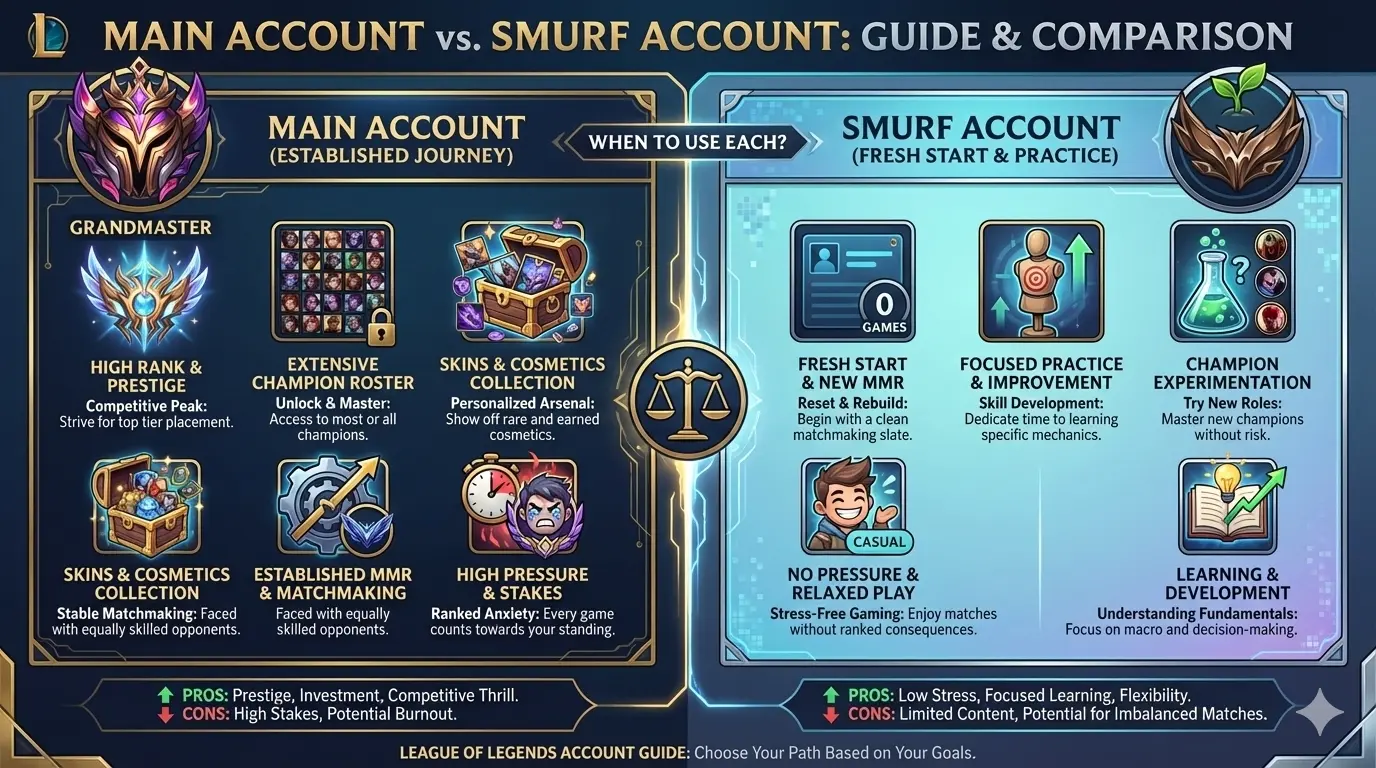
Before we get into scenarios, let's lay out what each account type actually gives you. No sugarcoating.
- Established MMR (stable but hard to move)
- Full champion pool and skins
- Honor level and ranked rewards history
- Friends list and club connections
- LP gains reflect your true skill bracket
- Years of match history for tracking improvement
- Volatile MMR (moves fast in either direction)
- Massive LP gains early (+28 to +35)
- Zero pressure — nothing to lose
- Perfect for testing new roles or champs in ranked
- Bypasses "calcified" MMR on old accounts
- Can place higher than your main if you play well
The key difference isn't about which one is "better." It's about MMR flexibility. Your main account has hundreds or thousands of games telling the system exactly where you belong. A fresh account has none of that. The system is guessing, and if you play well during that guessing phase, it guesses high.
This is why you'll see streamers place a fresh account in Emerald while their main is stuck in Plat. Same player, same skill, different MMR trajectory. If you want to understand the math behind this, our MMR guide breaks down exactly how the hidden number works.
When to Stay on Your Main
Your main account isn't the enemy. Sometimes it's exactly where you should be grinding. Here's when:
The honest truth: If your LP gains are even (like +20/-20) and you're winning more than 50% of your games, you're climbing. It's slow and it doesn't feel good, but the math is working in your favor. Patience beats panic every time.
When to Swap to a Smurf
Now here's where it gets real. There are legitimate situations where playing on your main is actively hurting your climb and your mental health.
Warning: If you're swapping to a smurf just because you lost two games, that's not strategy — that's avoidance. Smurfs are for specific situations, not an escape hatch every time ranked gets hard. You still have to actually improve at the game.
The Mental Game: Why Account Swapping Actually Works
Here's something nobody talks about: the psychological weight of your main account rank.
When you queue up on your main, every game carries baggage. You're thinking about your LP, your winrate, your promo series, whether you'll demote. That pressure makes you play scared. You don't take the aggressive flash-engage because "what if it doesn't work and I lose LP?" You don't roam because "what if my lane opponent gets plates?"
On a smurf? None of that exists. You play loose. You play confident. You take fights you'd never take on your main. And weirdly, you often play *better* because of it.
This isn't just anecdotal. It's basic performance psychology. Pressure makes you worse at complex tasks. League is one of the most complex games ever made. Remove the pressure, and your actual skill level comes through.
Pro tip: If you notice you consistently perform better on your smurf than your main, the problem isn't your MMR — it's your mental. Try treating your main like a smurf for 20 games. Mute all, don't check LP after games, and just play. You might be surprised.
Limit Testing: The Smurf Account Advantage
"Limit testing" is a term high-elo players use for pushing your champion to the absolute edge of what's possible. Tower diving at level 3. Flash-engaging into 3 people. Taking fights you "shouldn't" win to learn exactly where the line is.
You cannot limit test on your main. Not if you care about your rank. Every failed tower dive is -20 LP and a step closer to demotion. So you play safe, you play passive, and you never actually learn what your champion can do.
A smurf account is your training ground. It's where you learn that Irelia can actually 1v2 at level 6 if you hit your E. It's where you discover that Thresh can flash-flay-hook and delete a carry before they react. These are things you'd never try on your main, but once you learn them on a smurf, you bring that knowledge back.
The best players in the world didn't get there by playing safe. They got there by dying thousands of times on secondary accounts figuring out exactly what's possible.
Playing with Friends (The Rank Gap Problem)
Ready to Start Fresh?
Hand-leveled, Vanguard-safe smurf accounts ready for ranked. Skip the grind and start climbing on an account that matches your real skill level.
Let's talk about the elephant in the room. Season 16 brought duo queue back across most ranks, but the rank restrictions still exist. You can't duo if the gap between you and your friend is too wide.
Here's the typical scenario: You're Platinum. Your friend just started playing and they're Bronze. You want to play ranked together because normals feel pointless. On your main, the client literally won't let you queue up.
A smurf account solves this instantly. You get an account that's around your friend's rank, you queue together, and everyone has a good time. Just remember two things:
1. Don't ego it. If you're a Plat player in Bronze lobbies, you don't need to prove anything. Play with your friend, help them learn, and don't turn it into a highlight reel. 2. The system will catch on. If you're winning 80% of games, your smurf's MMR will shoot up fast and you'll be back to facing players near your real skill level within 30-40 games. That's by design.
The Balance Strategy: Main as Tournament, Smurf as Practice
Here's the framework that actually works for most players:
The 70/30 Rule: Spend 70% of your ranked time on your main account. That's where the real climb happens. Spend 30% on a smurf for limit testing, learning new champions, playing with friends, or resetting your mental after a bad session. This ratio keeps you improving without burning out.
Think of it like a sport. Your main account is game day. You play your best champions, your best role, and you try to win every game. Your smurf is practice. You experiment, you take risks, you learn new things without consequences.
The players who climb fastest are the ones who use both accounts strategically. They're not running away from their main — they're using the smurf to become a better player so their main climbs naturally.
MMR on Fresh Accounts: Why the Climb Feels Different
If you've ever played on a fresh Level 30 account, you know the feeling. Everything moves faster. LP gains are huge. Skipping divisions feels normal. It's addictive.
Here's why: fresh accounts have what's called "volatile" MMR. The system has no data on you, so it's making wild guesses. Win 3 in a row? The system thinks you might be Diamond. Lose 3? Maybe you're Silver. Every game swings your hidden rating dramatically.
On your main with 2,000 games played, the system has a very confident estimate of your skill. It takes dozens of wins in a row to meaningfully shift your MMR. The ranked system is designed this way on purpose — it prevents lucky streaks from inflating your rank, but it also makes it brutally hard to climb when you've genuinely improved.
This is the real reason people buy smurfs. Not to stomp low-elo players. To get an account where the system actually responds to their current skill level instead of anchoring them to where they were 6 months ago.
Quick math: On a main with tanked MMR, climbing from Gold IV to Plat IV might take 150+ games at a 55% winrate. On a fresh account with the same winrate, you could place directly into Gold I and reach Plat in under 40 games. Same player, same skill, wildly different experience.
Vanguard and Account Safety in 2026
One thing that's changed since the old days: Riot's Vanguard anti-cheat is always watching. If you're going to use a smurf account, it needs to be a legitimate, properly aged account. Botted accounts, accounts with suspicious leveling patterns, or accounts that trip Vanguard's detection will get banned — and sometimes they'll flag your main too.
Check our Vanguard safety guide for the full breakdown on what's safe and what isn't in Season 16. The short version: hand-leveled, aged accounts from reputable sellers are fine. Anything that looks like it was mass-produced by a bot farm is a ticking time bomb.
When to Just... Play Your Main
I want to be real with you for a second. Sometimes the answer isn't a smurf account. Sometimes you just need to get better.
If you're Silver and you think a fresh account will magically place you in Gold, it won't — unless you've actually improved. A fresh account amplifies your current skill. If you're genuinely a Silver player, you'll place Silver on the new account too, just with better LP gains for a while.
The smurf advantage only kicks in when there's a gap between your actual skill and where your main account's MMR has you stuck. If you've been grinding, watching VODs, learning macro, and you're genuinely playing at a Plat level but your main is hardstuck Gold with +15/-22 LP gains? Yeah, a smurf makes sense.
If you're the same player you were last season and you just want a dopamine hit from big LP numbers? Save your money. The fresh account high wears off in about 50 games, and then you're right back where you started.
FAQ
---
Start Climbing Smarter
Check your hidden MMR to see where the system actually thinks you belong. If the number is way below your rank, it might be time for a fresh smurf. If it's close, keep grinding your main — you're closer than you think.
Browse NA Accounts | Browse OCE Accounts