Let's be brutally, painfully honest for a second: The League of Legends ranked system is designed to be addictive. It is designed to make you frustrated, then elated, then frustrated again, keeping you on the hamster wheel for as long as possible. In 2026, understanding how this system actually works is the difference between climbing to Diamond and being "hardstuck" in Emerald forever, convinced that Riot Games has a personal vendetta against you.
You might see a badge on your profile that says "Silver II" or "Platinum I," but I'm here to tell you that badge is a lie. It is a cosmetic sticker meant to make you feel good. The real game—the game that decides your fate—is happening under the hood, involving a hidden number called MMR (Matchmaking Rating). If you don't understand MMR, you are climbing blindfolded.
Here is the deep-dive truth about the Season 16 Ranked System, why it feels like it hates you, and how you can actually beat the math.
The Visual Rank vs. The Hidden Truth (MMR)
This is the concept that breaks most players' mental strength.
Your Rank (e.g., Gold IV) is just a visual indicator. It basically means "Congratulations, you won 51% of your last 100 games." Your MMR is a hidden, complex algorithm that Riot uses to determine how good you actually are compared to the rest of the server.
Here is the nightmare scenario that happens to thousands of players every day: You go on a lucky win streak. Maybe you duo with a good friend, or maybe you just get carried. You win 10 games in a row. Your Rank shoots up from Silver II to Gold IV. You feel great. You pop the champagne. You are a Gold player now!
*However*, your MMR moves slower than your Rank. The system isn't convinced you're actually Gold yet; it thinks you just got lucky. It thinks you are a Silver II player wearing a Gold IV costume. So now, you have the Rank of a Gold player but the MMR of a Silver player.
The system tries to "correct" this mismatch. It says, "Hey, this guy is ranked too high for his skill level. We need to push him down." So it starts giving you +16 LP for a win and -28 LP for a loss. It is actively trying to demote you. This isn't a bug; it's a feature. This is what players call "Elo Hell" or being "Hardstuck." To fix it, you have to win consistently (55%+ winrate) over hundreds of games to convince the system your MMR deserves to rise. It is a grind that can take months.
The Ladder: From Iron to Challenger (A Reality Check)
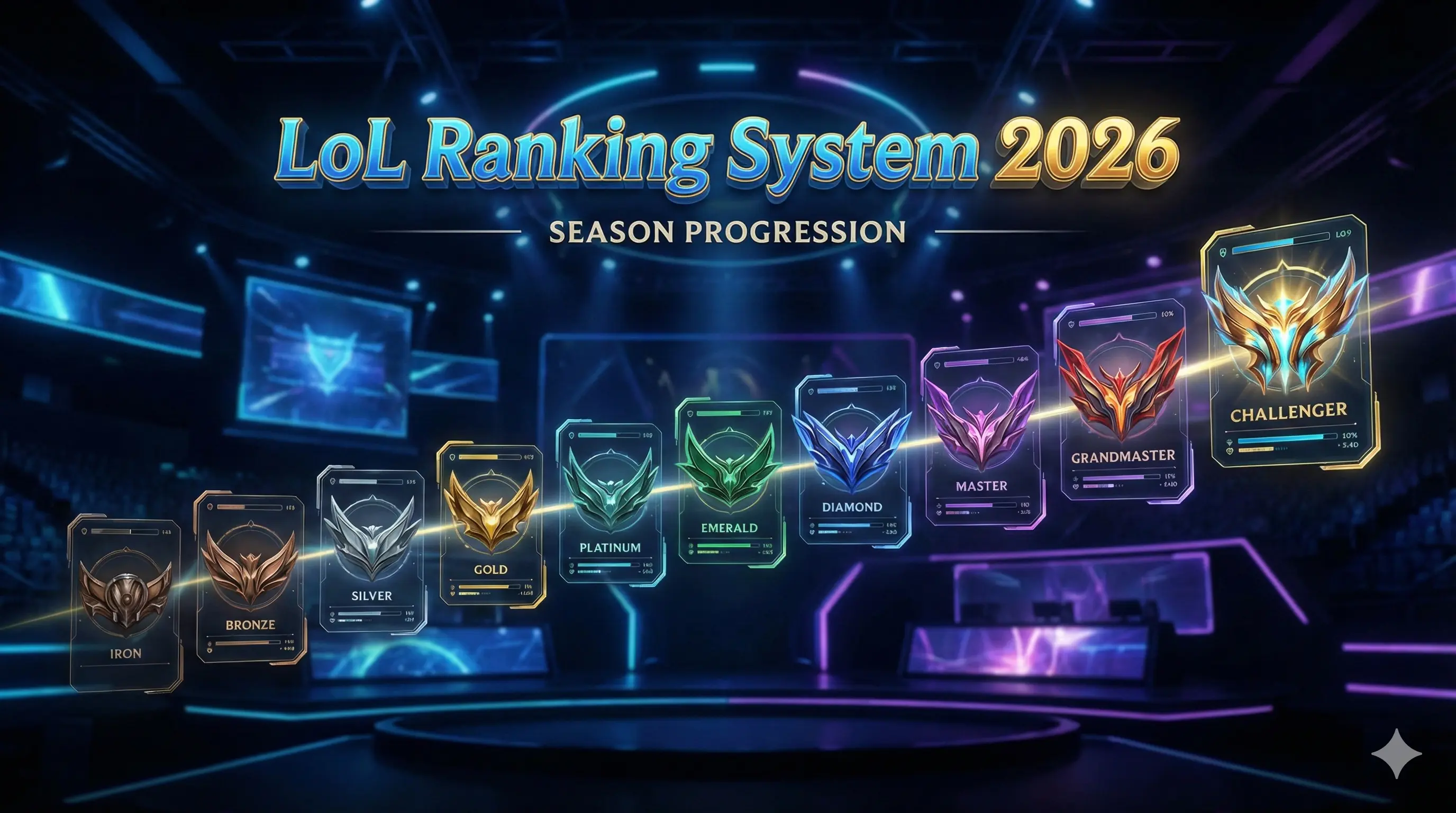
The ranked ladder has evolved significantly over the years. It used to be simple: Bronze, Silver, Gold, Plat, Diamond. Now, the distribution has shifted, and understanding where you really sit is crucial for your ego.
1. Iron & Bronze: This is the Wild West. This is the tutorial. If you are here, you are battling against people playing on trackpads, people disconnecting every third game to eat dinner, and people playing AP Zed. There is no meta here. There are no rules. 2. Silver & Gold: The masses. This is where the average player lives. The mechanics are okay—people can hit skillshots—but the macro (decision making) is non-existent. People will chase a kill into the enemy fountain instead of taking a free Baron. 3. Platinum: The Ego Zone. Players here think they are gods because they escaped Gold. They will type novels in chat explaining why it's your fault they died 1v1. They have good mechanics but terrible mental strength. One death and they type "FF15." 4. Emerald: The true "Elo Hell." Introduced a few years ago to bridge the massive skill gap between Plat and Diamond, Emerald is a chaotic mixing pot of washed-up Diamond players, lucky Platinum players on win streaks, and smurfs. The skill disparity in Emerald is wider than the Grand Canyon. One game you have a Faker wannabe, the next you have a jungler who doesn't know what a dragon is. The mental resilience required to leave Emerald is higher than any other tier. 5. Diamond: The beginning of "High Elo." The tutorial is over. Here, mistakes are punished instantly. If you step up too far, you die. 6. Master, Grandmaster, Challenger: The Apex Tiers. Here, LP isn't capped at 100. You just keep going. It's a daily grind to stay active and avoid decay. These are the top 0.5% of players in the region.
Why "Fresh Accounts" are the Meta
You will often see streamers, YouTubers, or high-elo players ditching their main accounts to play on "Fresh Accounts." Why? Are they just bullies who want to stomp noobs?
Sometimes, yes. But mostly, it comes back to MMR. An old account that has been Silver for 4 seasons has "calcified" MMR. Detailed mathematical confidence intervals tell the system "We are 99% sure this player is Silver II." Moving that MMR is like trying to push a boulder up a hill. It takes hundreds of games to shift the system's confidence.
A Level 30 Fresh Account has no history. It has "volatile" MMR. If you win your first 5-10 placement games on a fresh account, the system goes, "Whoa, this guy is a smurf! We need to place him higher!" and skyrockets your MMR. You might place visually in Gold, but you'll be playing against Emeralds and gaining +35 LP per win. You can skip entire divisions (e.g., jump from Gold IV to Gold II instantly).
This is why smurfing is so efficient for climbing. It's not just about easier games; it's about circumventing the grind of fixing a doomed MMR on an old account. It's a shortcut through the math.
The Season Split System: No Rest for the Wicked
In Season 16, we have three Splits per year. This means your rank "soft resets" every 4 months.
- The Good: If you start the season terribly and tank your MMR, you get a fresh start in May and September. You aren't doomed for the whole year.
- The Bad: You never really get to rest. If you want the rewards (Victorious Skins), you have to grind year-round. The moment you stop, you start decaying (in higher tiers) or falling behind the curve.
How to Actually Climb (The Mental Game)
Forget the LP. Ignore the +15/-25 numbers. They will only tilt you. Focus entirely on Win Rate. If you maintain a 51% win rate, you *will* climb. Mathematically, it is inevitable. It might take 500 games, but you will climb. Want to know exactly how many? Use our climb calculator to get the exact number based on your rank and winrate. If you want to climb *fast*, you need a 60%+ win rate.
And if you find yourself with a 48% win rate and gaining +14 LP per win? I'm sorry to be the bearer of bad news, but that account is "cooked." The amount of time it would take to fix that MMR is likely longer than it would take to just level a new account or buy one. You are swimming upstream against a current designed to hold you back.
Before you write the account off, check the actual number. Our free MMR checker tells you whether your MMR is genuinely cooked or just sitting a division behind your rank, and the Hardstuck Report reads your last 20 games to answer the real question: is it you, or is it the lobby. Not sure which checker to trust? We tested every one.
If you are losing more on a loss than you gain on a win (e.g., +18/-22), the system has flagged you as "imposter." You are in for a world of pain. It might be time to cut your losses and save your mental health.
Ready to start your climb?
See where you'll land in our Season 16 Ranked Reset Guide or learn How to Smurf Safely with a secondary account.
---
🚀 Reach Your Peak Today
Don't let a bad MMR hold you back. Start fresh with a Vanguard-safe, aged account and reach the rank you deserve.
Browse NA Accounts | Browse OCE Accounts