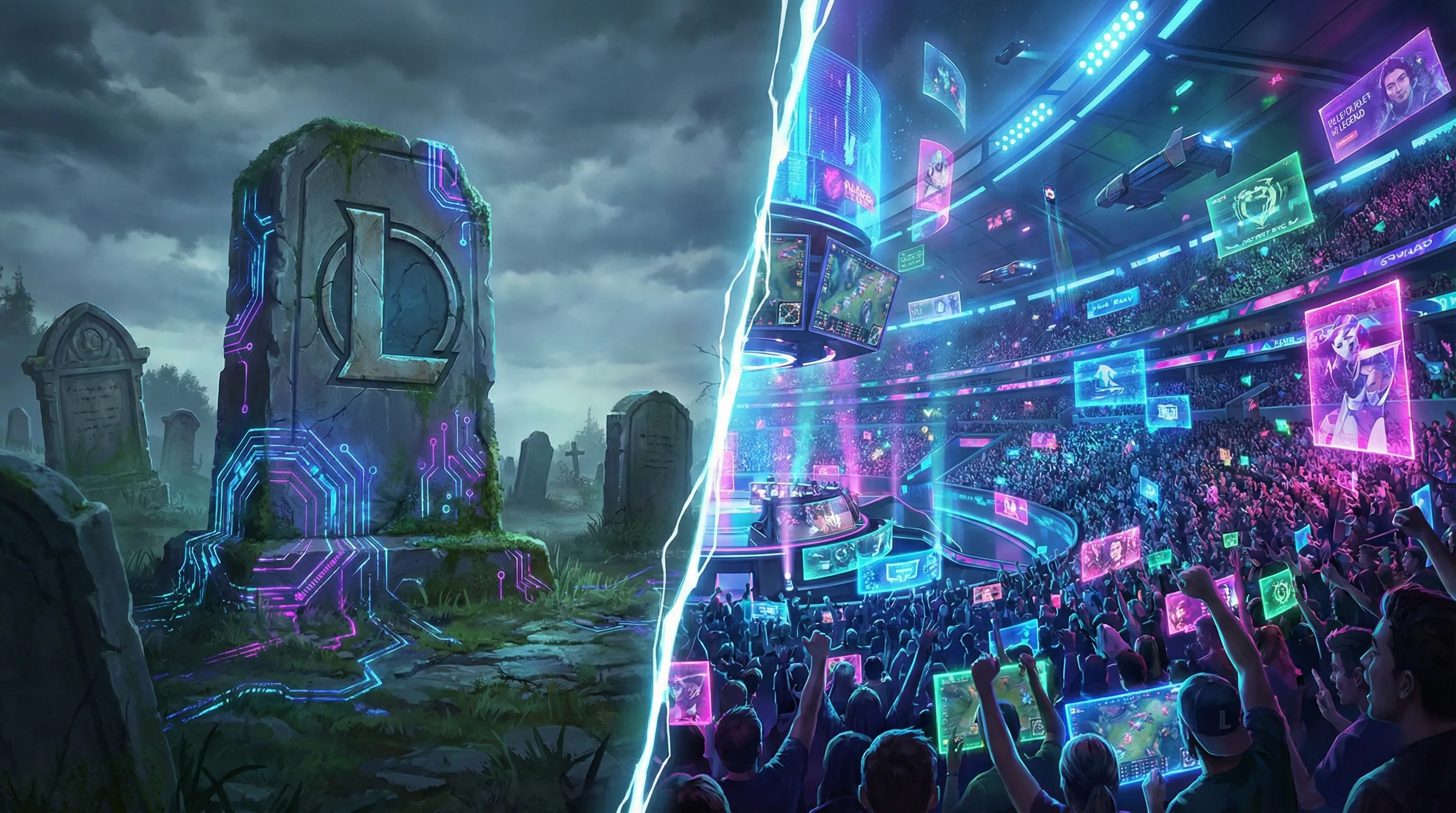
"Is League of Legends dying?" gets typed into Google roughly 50,000 times a month. It's been asked every single year since about 2014. And every single year, the answer is the same: no. Not even remotely.
But the question keeps coming back like a Karthus ult you can't Zhonya's. So instead of just saying "no" and moving on, let's actually look at the numbers — the real ones, not some Reddit doomer's vibes-based analysis.
Yeah. Some dead game.
Why People Keep Saying League Is Dying
Let's be fair here. The "dead game" crowd isn't entirely making stuff up. They're just looking at the wrong data — or looking at the right data from the wrong angle.
The NA/EU bubble. North America has roughly 4 million monthly players. Europe (EUW + EUNE combined) has about 12 million. Together, that's maybe 12% of the global playerbase. When your server feels quieter at 2 AM on a Tuesday, that's not the game dying. That's you living in a region that represents a fraction of the total audience. China alone has 70-80 million players. The game isn't dying — your server is just small.
Twitch numbers fluctuate. League's Twitch viewership goes up during Worlds and big streamer events, then drops during off-season. People see a slow January and tweet "dead game lol." Meanwhile, Worlds 2024 hit 6.94 million peak concurrent viewers — the highest esports viewership event ever recorded at the time. Twitch daily numbers are not a health metric for a game where most of the playerbase is in Asia and doesn't use Twitch.
Nostalgia is a hell of a drug. If you started playing in Season 3 or 4, you remember a different game. Smaller community, everything felt new, your first pentakill hit different. That feeling is gone and it's never coming back. But that's not the game dying — that's you getting older. The game itself is bigger than it was during your "golden era."
The Reddit echo chamber. Every week, a post titled "I'm finally quitting League" gets 5,000 upvotes. The comments are full of people agreeing. Then you check their op.gg and they played 3 games yesterday. The "quitting League" post is basically a genre of creative writing at this point.
Is League of Legends Dying? The Player Count Says No
Here's the actual trajectory. These numbers are compiled from Riot Games announcements, DemandSage, and multiple third-party analytics trackers.
| Year | Monthly Active Players | Trend | What Happened |
|---|---|---|---|
| 2011 | ~15M | ↑ | Season 1, first Worlds at DreamHack |
| 2012 | ~32M | ↑ 113% | Season 2 Worlds draws 8.2M viewers |
| 2013 | ~67M | ↑ 109% | Faker debuts, Asia goes all-in |
| 2014 | ~67M | → | Plateau, but esports keeps growing |
| 2015 | ~90M | ↑ 34% | Worlds fills stadiums, SKT dynasty |
| 2016 | ~100M | ↑ 11% | Riot officially confirms 100M players |
| 2017 | ~100M | → | Steady, first "dead game" memes appear |
| 2018 | ~80M | ↓ 20% | Fortnite pulls casual players away |
| 2019 | ~90M | ↑ 12% | Recovery begins, Arcane announced |
| 2020 | ~115M | ↑ 28% | COVID lockdowns boost all gaming |
| 2021 | ~150M | ↑ 30% | Arcane S1 on Netflix, massive spike |
| 2022 | ~180M | ↑ 20% | All-time peak, post-Arcane momentum |
| 2023 | ~150M | ↓ 17% | Normalization after COVID/Arcane spike |
| 2024 | ~131M | ↓ 13% | Stabilizing, Arcane S2, T1 back-to-back Worlds |
| 2025 | ~120-135M | → | T1 three-peat, record Worlds viewership |
| 2026 | ~131M+ | ↑ | Season 16 brings biggest changes in years |
Here's what that table actually tells you: League peaked at ~180M during the COVID + Arcane perfect storm in 2022. It's since settled back to ~131M. That's not dying — that's a game returning to its natural baseline after an anomalous spike. 131 million monthly players is still absurdly massive. For context, that's more than CS2, Valorant, Dota 2, and Apex Legends *combined*.
The Money Doesn't Lie
Player counts can be estimated and debated. Revenue? That's in financial filings. And the numbers are staggering.
According to The Irish Times, Riot Games' EMEA headquarters in Dublin reported €1.85 billion in revenue for 2024, with profits spiking to €587 million. That's just the EMEA arm — not global.
Industry analysts at Latterly estimate Riot's total 2024 revenue at $2.2-2.4 billion, with League of Legends contributing the largest share through skins, event passes, and in-game content.
Lifetime? League has generated roughly $19 billion in total revenue since 2009. For a free-to-play game. Let that sink in.
Nobody invests billions into a dying product. Riot is still hiring, still releasing champions (we're at 172 and counting), still running global esports leagues, and still pumping out skins at a pace that would make a fashion brand jealous. There are over 1,700 skins in the game now.
Worlds Viewership Keeps Breaking Records
If League were dying, you'd see it in the esports numbers first. Pro viewership is the canary in the coal mine for competitive games. So let's check on that canary.
| Year | Peak Concurrent Viewers | Finals |
|---|---|---|
| 2019 | 3.98M | FunPlus Phoenix vs G2 |
| 2020 | 3.88M | DAMWON vs Suning |
| 2021 | 4.01M | Edward Gaming vs DAMWON |
| 2022 | 5.15M | DRX vs T1 |
| 2023 | 6.4M | T1 vs Weibo (Faker's 4th) |
| 2024 | 6.94M | T1 vs BLG (Faker's 5th) |
| 2025 | ~6.7M | T1 vs KT Rolster (three-peat) |
*Sources: Esports Charts, esportsbets.com. Numbers exclude Chinese platforms which report differently.*
Worlds 2024 set the all-time record at 6.94 million peak concurrent viewers. Worlds 2025 came in just behind at ~6.7 million — the second most-watched esports event ever. T1 and Faker owned 8 of the 10 most-watched League matches in 2025 according to Esports Charts data.
The trend line is going up, not down. Every year since 2019, Worlds has drawn more viewers than the year before (with 2025 being a marginal dip from 2024's all-time record). That's not what a dying esport looks like.
League vs Every Other Game
You want to know what a dying game looks like? Compare League to its competition.
League has roughly 4x the playerbase of Valorant — Riot's own newer game. It has 10-13x the playerbase of Dota 2, its closest genre competitor. Even Fortnite, which was supposed to kill every game in existence back in 2018, sits well below League's numbers.
And here's the thing that really puts it in perspective: most competitive games bleed players within 5-7 years. Overwatch launched in 2016 and is already on life support with OW2. Apex peaked in 2020 and has been declining since. PUBG went from 3 million concurrent on Steam to a fraction of that.
League has been running for 16+ years and still has 131 million monthly players. Name another game that's done that. You can't, because there isn't one.
Season 16: Why League Is Actually Growing Again
Here's where it gets interesting. League isn't just surviving in 2026 — there are signs it's actually picking up momentum again.
Season 16 launched on January 8, 2026, and it brought the most significant gameplay changes in years. We're talking:- Role Quests — every role now has a unique quest that unlocks a role-specific power. Top laners can hit level 19. ADCs get a 7th item slot. Mid gets Tier 3 boots. Support gets extra wards. Jungle gets bonus XP. It's the biggest shake-up to role identity since the game launched.
- Faelights — a new vision mechanic that replaces some of the old warding patterns
- Atakhan removed — the controversial epic monster from Season 15 is gone, and Baron is back to spawning at 20 minutes
- 200% base crit damage — ADCs actually feel like carries again
- Demacia-themed map — Summoner's Rift got a visual overhaul with Demacian aesthetics
- 11 new items including the return of Hextech Gunblade
The Competition Imploded
Part of League's resilience in 2026 is that the competition keeps shooting itself in the foot.
Overwatch 2 alienated its entire fanbase with aggressive monetization and the removal of the original game. The player count has cratered.
Every new MOBA dies. Predecessor, Fault, Predecessor again — every MOBA that's tried to challenge League or Dota in the last 5 years has failed within months. The genre has a massive barrier to entry and League owns it.
Dota 2 is bleeding players. Valve's attention has been split across multiple projects, and Dota's monthly player count has been in slow decline for years. The game still has a passionate community, but it's a fraction of League's size.
Valorant hit a ceiling. Riot's own FPS is healthy at 30-35M monthly players, but it hasn't grown significantly in the last year. The tactical shooter market is crowded, and Valorant's high skill floor makes casual play rough.
When your competitors are either stagnating or actively self-destructing, just being consistently good is enough to win. And Riot has been consistently good with League for 16 years.
OK, But What IS Actually Concerning?
I'm not going to pretend everything is perfect. If you want a pure cheerleading article, go read a Riot press release. Here's the stuff that's genuinely worth watching:
NA is small and getting smaller relative to other regions. North America's ~4 million players represent about 2% of the global playerbase. High elo queue times in NA are genuinely painful — 10-30+ minutes for Challenger players. If you're in NA and the game "feels dead," it's because your region is tiny, not because the game is dying globally.
Skin pricing has gotten aggressive. The $400+ Ahri skin, the constant prestige editions, the gacha-style loot mechanics — Riot is squeezing harder on monetization. This doesn't mean the game is dying (the revenue numbers prove otherwise), but it does mean the free-to-play experience is getting more "free-to-play-but-we-really-want-your-money."
New player experience is still rough. 172 champions to learn, a toxic community, and a steep learning curve make League one of the hardest games to get into as a new player. Riot has made improvements, but the onboarding is still miles behind what it should be for a game this size.
Toxicity hasn't been solved. It's been 16 years and people still flame you for picking Teemo support. The report system catches the obvious stuff, but League's toxicity problem is baked into the game's DNA at this point. It's the single biggest reason people actually quit — not balance changes, not new champions, not the meta. Just other players being awful.
The post-Arcane normalization is real. Going from 180M to 131M looks scary on a graph. But 2022 was an anomaly driven by COVID lockdowns and the Arcane Netflix effect. The game was always going to come back down from that. 131M is still higher than the pre-COVID baseline of ~100M, so the net effect of the last few years is still positive growth.
What Keeps 131 Million People Playing?
If the game were bad, people would leave. 131 million people don't log in every month out of obligation. So what's the hook?
Biweekly patches. Riot patches the game every two weeks. The meta never stays the same for long. Your main gets nerfed? Time to learn something new. That champion you hate? They'll get adjusted eventually. The constant evolution keeps things fresh in a way that most games can't match.
The ranked ladder is addictive. The ranked system is one of the best in gaming. The dopamine hit of a promotion, the tilt spiral of a loss streak, the "one more game" at 3 AM — Riot has perfected the psychological loop. Season 16's improvements (mirrored autofill, no banning teammate hovers) made it even smoother.
172 champions = infinite variety. With over 172 playable champions, no two games play exactly the same. You can put thousands of hours in and still discover new matchups and synergies. The champion roster is League's biggest asset.
Esports gives it meaning. Having a thriving pro scene makes your own ranked games feel connected to something bigger. You watch Faker play Azir, you try Azir in your next game, you feed, you go back to playing Annie. But the aspiration is there. The LCK alone pulled 3.95 million peak viewers across its 2025 season.
Sunk cost (let's be real). If you've spent $500 on skins and 3,000 hours on the game, you're not walking away easily. Riot knows this. The skin economy is designed to keep you invested — literally. And with rare skins becoming status symbols, the incentive to stay only grows.
Your friends play it. League is fundamentally a social game. You queue with friends, you suffer together, you blame each other for the loss, you queue again. Those social bonds are stronger than any balance patch or meta shift.
Is League of Legends Worth Playing in 2026?
If you're reading this because you're thinking about starting (or coming back), here's the honest answer: yes, but know what you're getting into.
The game is in one of its best states mechanically. Season 16's changes have been well-received. The role quest system gives every position a unique identity. The champion pool has never been more diverse. And if you care about ranked, the MMR system is more transparent than it's ever been — you can even check your hidden MMR with third-party tools.
The downsides are the same as they've always been: the community can be toxic, the learning curve is steep, and you will lose games that feel completely out of your control. That's League. It's been that way since 2009 and it'll be that way in 2036.
But if you can handle that? There's nothing else like it. No other game offers this combination of strategic depth, mechanical skill expression, and competitive infrastructure. That's why 131 million people keep coming back.